
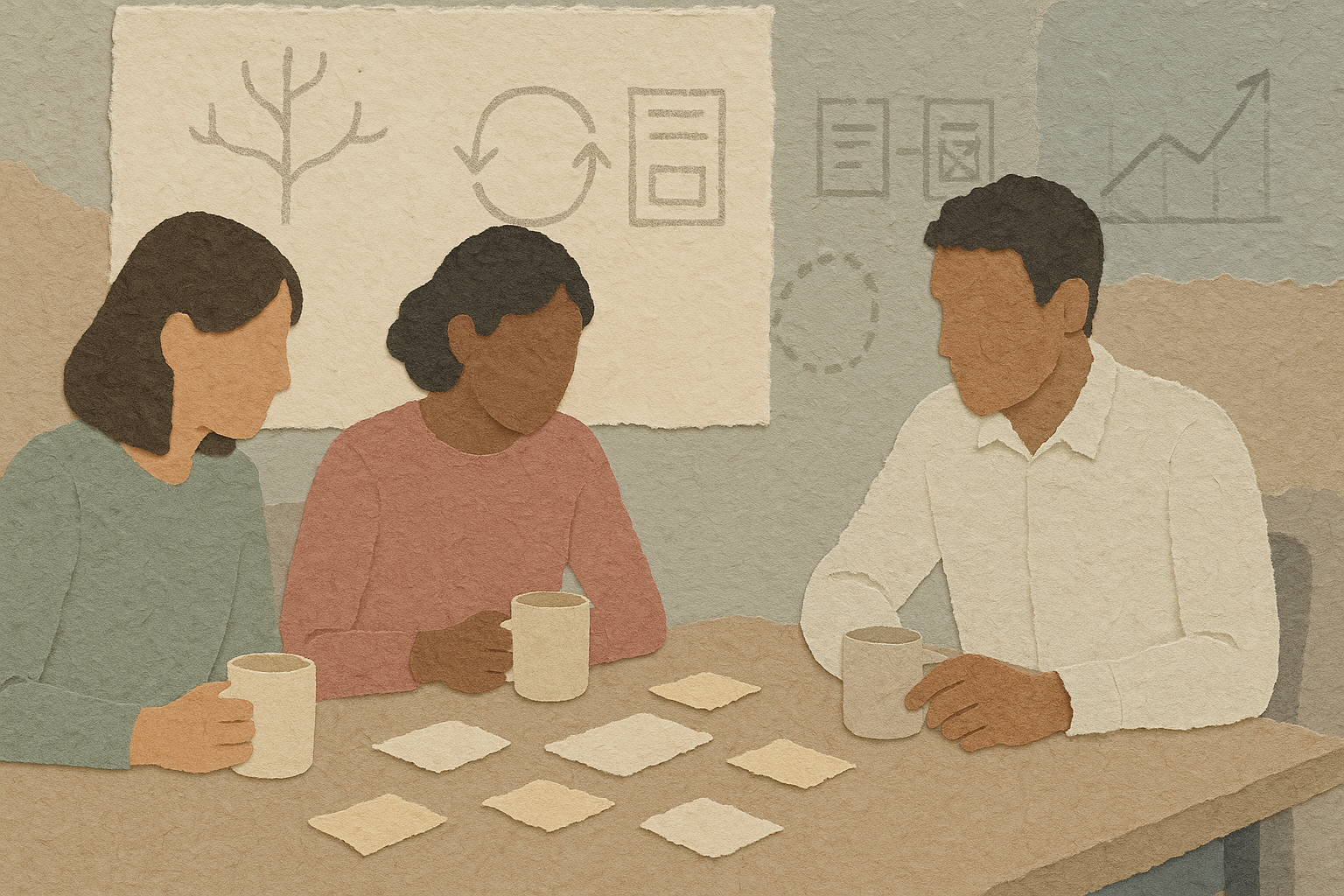
Imagine you just swapped freelance wireframes for your first in-house role. It’s day one. You open Slack and see, “The product trio is mapping the OST before tomorrow’s OKR check-in.” You scroll again, hoping for context. Nothing.
The jargon feels like showing up in Paris with only high-school French. The good news is, just like a travel phrasebook, a handful of key terms can turn confusion into connection. Below is a designer-friendly glossary that lines up with moments you’ll live through in a typical discovery-to-delivery cycle. Plus, a few usage tips so these words sound natural, not forced.
Your Go-To People
Product Trio
The trio is the smallest decision-making unit: product manager, product designer, and lead engineer sitting side by side, shaping problems and solutions together. Teresa Torres popularized the idea, pointing out how three perspectives balance user value, business goals, and technical realities in real time. (source: producttalk.org)
Squad
A squad, from Spotify’s playbook, is a cross-functional team—usually six to twelve people—that owns a slice of the product from start to finish. Your trio lives inside this squad, but you also lean on QA, data analysts, and sometimes a content designer. (source: chisellabs.com)
Tribe, Chapter, Guild
When multiple squads chase the same mission, they form a tribe. Inside a tribe, engineers with the same craft gather in chapters for mentorship, while guilds keep best practices consistent across the company. These terms pop up fast in calendar invites—better pin them now.
Discovery (the What Should We Build? Phase)
Continuous Discovery
Continuous discovery is a mindset, not just a project. Teresa Torres calls it weekly touchpoints with customers plus quick tests of trio-generated ideas. If someone asks, “Do we have a CDH cadence?” they want to know if those weekly interviews are actually happening. (source: producttalk.org)
Dual-Track Agile
In dual-track teams, discovery and delivery happen side by side. Designers and engineers prototype and test while code ships from the last sprint. This keeps learning and building tightly connected. (sources: devsquad.com, productplan.com)
Opportunity Solution Tree (OST)
Imagine a whiteboard tree: the trunk is your goal, branches are user opportunities, leaves are possible solutions. The OST shows why an idea exists before anyone falls in love with mock-ups. Knowing how to sketch one earns instant credibility. (sources: producttalk.org, product-frameworks.com)
Assumption Mapping
A quick workshop that sorts the trio’s assumptions by evidence and risk. High-risk, low-evidence ideas trigger research tasks. Drop the phrase “Let’s map our riskiest assumptions” when a brainstorm feels heavy on opinion.
Delivery (the Let’s Ship It Phase)
Sprint
A sprint is a fixed period, often two weeks, ending with working software. Design work may wrap sooner, but share your prototypes in sprint reviews so everyone sees the upcoming piece in context.
Backlog Refinement
Also called grooming, this is where the trio breaks big problems into stories, writes acceptance criteria, and sets priorities. It’s the secret sauce to avoiding “design-then-build” waterfalls inside Agile.
Story Points and Velocity
Story points are relative estimates—often Fibonacci numbers—that spark conversations about complexity. Velocity is how many points a squad usually finishes in a sprint. Remember, velocity is a thermometer, not a thermostat; chasing it directly can lead to burnout.
Definition of Done
Your “done” checklist locks in quality. Usually it covers code review, accessibility, analytics, and release notes. If you’re new, volunteer to update the Definition of Done. It’s a great way to learn how each discipline measures finished work.
Continuous Integration / Continuous Deployment (CI/CD)
CI/CD pipelines automate tests and releases so small changes can ship safely. When engineers say, “This feature is behind a flag, we can CI it today,” they mean you can test in staging while development continues.
Goals (the Compass for Both Tracks)
North Star Metric
The North Star Metric (NSM) is the single number that best captures the value your product delivers. Think weekly active teams for Slack or nights booked for Airbnb. The NSM helps squads focus on impact over output. (sources: justanotherpm.com, productschool.com)
Objectives and Key Results (OKRs)
Objectives are inspiring, qualitative goals. Key results are measurable milestones. When planning, make sure your solution tree branches ladder up to at least one key result.
Leading versus Lagging Indicators
Leading metrics move quickly and hint at future success. Lagging metrics confirm results later. For example, adding a card to a wallet might be leading, while monthly transaction volume lags. Using both keeps celebrations grounded.
Research and Design Artifacts
User Interview
Still the fastest way to uncover pain points. Trio members often shadow each other’s interviews to catch every nuance.
Journey Map
A visual timeline of user steps, emotions, and touchpoints. Engineers appreciate it when error logs overlay the map—they see exactly where the code breaks feelings.
Jobs-to-Be-Done (JTBD) and Job Stories
JTBD reframes problems around the progress a user wants. Job stories—“When ___, I want to ___, so I can ___”—turn those insights into design triggers. Use job stories during refinement to keep criteria user-centered.
Rapid Prototyping
Whether a Figma mock, command-line sketch, or Wizard-of-Oz chat flow, speed matters. Saying “High fidelity looks low-risk, but let’s start with paper prototypes” wins respect from time-pressed engineers.
Communication Rituals
Daily Stand-Up
Fifteen minutes, cameras on, everyone answers three questions: What did you do? What will you do? Any blockers? As a new designer, use this time to ask quick clarifications instead of scheduling more meetings.
Sprint Review
A live demo for stakeholders. Designers should show research clips or design decisions alongside engineering walkthroughs, framing how each increment moves the OKR needle.
Retrospective
A safe space to reflect on the process, not the product. Bring one praise, one pain point, and one idea. Consistent contributions show you care about team health.
Stakeholder Update
When time zones clash, squads email or post a short Loom video covering outcomes, next bets, and help needed. Echoing trio terms in updates prevents translation errors higher up.
Mini Phrasebook in Action
Try reading this aloud. It shows how these terms flow naturally in conversation:
“Our product trio kicked off Q3 by revisiting the North Star Metric. We spotted a drop in weekly active teams, so during continuous discovery interviews we mapped an opportunity solution tree. Refinement broke the top opportunity into three epics, and dual-track allowed us to prototype while engineering closed the previous sprint. Story points looked steep, so we trimmed scope behind a feature flag. By sprint review, the prototype cleared usability tests, and the squad shipped the first slice through CI/CD. Stand-up tomorrow will set new leading indicators, then we loop.”
Feel that rhythm? Using terms like this helps you remember definitions faster than memorizing bullet points.
Signing Off
Working inside a product trio is part craft and part conversation. Nail the vocabulary early, and meetings shift from confusing to collaborative. Keep this phrasebook handy, try one term per meeting, and watch how quickly you become fluent.
