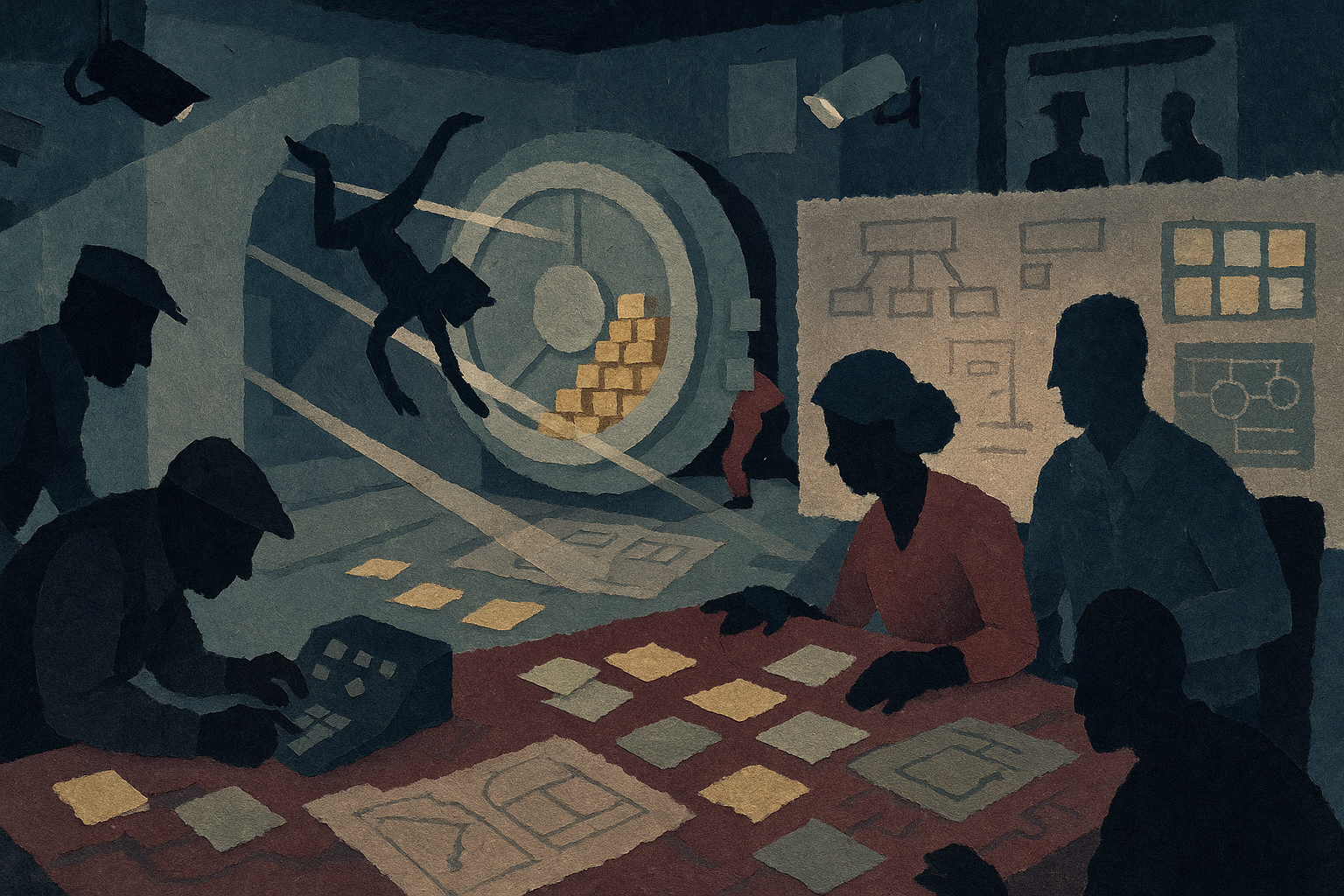
I queued up Ocean’s Eleven one night thinking I’d let it run in the background while I caught up on some design cleanup. But halfway through the vault-camera montage, I paused the movie, closed my laptop, and grabbed a notebook.
It was all there. A high-stakes plan, the right mix of people, no extra fluff, and a surprising amount of preparation. Every moment of the heist reminded me of leading a multi-team product launch.
By the time the crew walked away from the Bellagio fountains, I had a fresh playbook in hand. Here’s what I took from the movie and how it translates to product work.
1. Assemble specialists, not clones
🎬 Scene Setup
Danny brings together a crew of experts. Everyone has a role. There’s a contortionist, a getaway driver, a demolitions expert, and a card shark. No one overlaps, and every part of the plan has a clear owner.
✏️ Design Takeaway
Great teams aren’t made up of people who can all do the same thing. They’re made up of individuals with unique strengths who know exactly what they’re responsible for. Overlap leads to confusion. Specific roles lead to speed and trust.
💡 Idea for You to Try
Look at a big upcoming release. Can you name one person who owns accessibility? Who handles data validation? If you’re seeing double names or blank spaces, tighten your lineup before the work starts.
2. One impossible objective, crystal clear
🎬 Scene Setup
The crew repeats the mission again and again: steal $160 million from three casinos in one night. Everyone is locked in. No one forgets the goal.
✏️ Design Takeaway
Your team should be able to say the product goal in one sentence. If it’s too long, too vague, or full of filler, it won’t stick. A clear mission keeps everyone focused and makes it easier to say no to distractions.
💡 Idea for You to Try
Write your current project goal on a sticky note. If it doesn’t fit or if it’s confusing when read out loud, try again. Aim for clarity, not flair.
3. Blueprints before bravado
🎬 Scene Setup
Before anyone dresses up or steps into the casino, the team maps everything out. They diagram the vault, tap security lines, and test gear in the desert. Nothing flashy, just solid prep work.
✏️ Design Takeaway
Good-looking UI isn’t a replacement for system planning. Start with architecture, workflows, and edge cases. Save the polish for later.
💡 Idea for You to Try
Before your next review meeting, map out the entire user journey on paper. Include what happens when things go wrong. What if data fails to load? What if someone closes the tab too early?
4. Dry-run the fail states
🎬 Scene Setup
The team builds a fake vault and practices the plan over and over. Yen trains in a replica tunnel. The laser grid gets replaced with light bulbs. Everyone learns what could go wrong while the stakes are low.
✏️ Design Takeaway
Test failure early and safely. Use staging environments. Use feature flags. Set up mock data. Make sure everyone knows what will happen if things fall apart.
💡 Idea for You to Try
Pick a major feature and run a failure simulation. Break a dependency and see what happens. Ask your team how they’d recover, and build that plan in advance.
5. Diversions protect core threads
🎬 Scene Setup
While one part of the crew fakes a SWAT team raid, another team walks out with the money. The chaos isn’t for show. It creates space to work without interruption.
✏️ Design Takeaway
Sometimes, the best way to ship quietly is to let attention settle somewhere else. A small UI change or feature teaser can buy time while bigger work happens under the surface.
💡 Idea for You to Try
Planning a major backend migration? Pair it with a small but noticeable front-end update. Keep users focused while your infrastructure team gets room to breathe.
6. Rehearse the hand-off
🎬 Scene Setup
Once the heist is complete, every crew member knows where to go. There’s no panic. No guessing. The exit plan is already in place.
✏️ Design Takeaway
After a big launch, the next steps matter just as much. Who’s watching the metrics? Who’s answering support tickets? Who can hit rollback if needed?
💡 Idea for You to Try
Create a post-launch checklist. Assign names to each task before the launch ever happens. That way, when it goes live, no one is scrambling.
Mini‑workshop: build your eleven‑slot crew card
Time required: about 15 minutes
- Write your main objective in a single sentence.
- Draw eleven blank circles on paper or a whiteboard.
- Label them: Vision, UX, Visual Design, Research, Copy, Front-end, Back-end, QA, DevOps, Analytics, Comms.
- Add real names to each slot. If any are blank or repeated, take note.
- For each role, jot down one risk that person helps prevent.
If the board looks lopsided, adjust the plan before kicking off. It’s easier now than midway through a sprint.
Planning with the calm of Clooney
Nothing in Ocean’s Eleven happens by luck. Every win comes from practice, clarity, and trust. It’s not just a heist movie. It’s a blueprint for any complicated launch.
Make the goal obvious. Choose your team carefully. Practice the hard parts. And when you pull it off, walk away calm and confident.